
Can Constipation be the Hidden Culprit of Your Persistent Low Back Pain?

Updated: Dec 30, 2025

The Surprising Connection: Why Your Constipation Might Be Causing Your Back Pain and Painful Sex
What Your Doctor Isn't Telling You About These "Unrelated" Symptoms
You've been dealing with three frustrating problems:
Chronic constipation that makes every trip to the bathroom a struggle
Nagging low back pain that won't quit
Pain during sex that's affecting your relationship
Your gastroenterologist treats your gut. Your chiropractor adjusts your back. Your gynecologist says, "Everything looks normal."
But no one is connecting the dots.
What if I told you these three symptoms aren't separate problems at all—but different expressions of the same root cause?
Welcome to the world of pelvic floor dysfunction.
The Hidden Link: Your Pelvic Floor
Your pelvic floor is a group of muscles that form a hammock at the base of your pelvis. These muscles control three critical functions:
Bowel movements (letting go when you need to go)
Sexual function (relaxing for penetration, contracting for orgasm)
Core stability (supporting your spine and pelvis)
When your pelvic floor muscles become too tight, weak, or uncoordinated, they can't do ANY of these jobs properly.
Result? Constipation. Back pain. Painful sex. All at once.
Let me explain how.
How Constipation, Back Pain, and Painful Sex Are Connected
The Constipation-Pelvic Floor Connection
Here's what should happen when you have a bowel movement:
Your rectum fills and signals "time to go"
You sit on the toilet
Your pelvic floor muscles RELAX (opening the pathway)
Your abdominal muscles gently contract
Stool passes easily
But when your pelvic floor is too tight:
Your rectum fills
You sit on the toilet
Your pelvic floor muscles STAY CLENCHED
You strain harder
Stool can't pass—or passes painfully
It's like trying to poop through a closed door.
No amount of fiber, water, or stool softeners will help if the exit route is clenched shut.
The Constipation-Back Pain Connection
When you're chronically constipated:
Your colon fills and stretches - creating pressure and inflammation
Your pelvic floor compensates - tight muscles pull on your tailbone and low back
You strain - increasing abdominal pressure that makes low back muscles tighten
Fascial connections tug - your colon is connected to your spine through fascia; when inflamed, it pulls on your back
Your body is all connected. When one part isn't working (constipated colon), everything attached to it suffers (your back).
The Constipation-Painful Sex Connection
When you're constipated:
Your rectum is full - stool takes up space; during penetration, pressure against the vaginal wall pushes on your full rectum = PAIN
Your pelvic floor is already tight - the same tight muscles preventing bowel movements can't relax for penetration = PAIN
Your tissues are inflamed - chronic constipation and straining cause inflammation; inflamed tissues hurt with any touch = PAIN
Your nervous system is on high alert - chronic pain puts you in fight-or-flight; your body anticipates pain during sex = muscle guarding = PAIN
It's a vicious cycle: Tight pelvic floor → constipation → more tightness → painful sex → nervous system alarm → even tighter pelvic floor
The Real Story: It All Comes Back to Your Pelvic Floor
Your pelvic floor muscles are like a dimmer switch—they need to turn UP (contract) for some activities and turn DOWN (relax) for others.
When healthy, they:
Contract to support organs, stabilize spine, prevent leaking
Relax to allow bowel movements, urination, and penetration
Coordinate with breath, core, and movement
When dysfunctional (too tight), they:
Can't relax for bowel movements → constipation
Pull on the tailbone and spine → low back pain
Can't allow penetration without pain → painful sex
All three symptoms. Same root cause.
Why Your Current Treatments Aren't Working
For constipation, you've tried:
Fiber supplements
Stool softeners
More water
Probiotics
For back pain:
Massage
Ibuprofen
Stretching
For painful sex:
More lubricant
"Just relax"
"Have a glass of wine"
None of it worked because you're treating symptoms, not the cause.
Fiber can't fix a clenched pelvic floor. Lubricant doesn't relax tight muscles.
The key is your pelvic floor.
The Signs Your Pelvic Floor Is the Problem
You might have pelvic floor dysfunction if you experience:
Bowel Issues:
Straining to have bowel movements
Feeling of incomplete emptying
Constipation despite fiber and water
Painful bowel movements
Hemorrhoids
Back/Pelvic Pain:
Low back pain that doesn't respond to typical treatment
Tailbone pain
SI joint pain
Hip or groin pain
Pain worse with sitting
Sexual Dysfunction:
Pain with penetration (entry or deep)
Burning or aching during/after sex
Feeling "too tight"
Difficulty using tampons
Pain with pelvic exams
Other Signs:
Frequent urination or urgency
History of trauma
High stress or anxiety
If you checked off multiple items in different categories, your pelvic floor is almost certainly involved.
What Actually Works: Comprehensive Pelvic Floor Therapy
The solution isn't treating constipation, back pain, and painful sex separately. It's addressing the pelvic floor dysfunction causing all three.

What You Can Try at Home
These can help—but they're NOT a replacement for comprehensive therapy.
For Bowel Movements:
Use a 6-9 inch step stool under feet while on toilet (Squatty Potty is my fav)
Breathe, don't strain—exhale and allow pelvic floor to relax ( you can also blow bubbles into a cup of water...Helps to prevent over-straining and maintain good breathing)
Go when you feel the urge
For Low Back Pain:
Child's Pose breathing (2-3 minutes daily)
Gentle pelvic tilts
For Painful Sex:
Pelvic floor relaxation breathing before intimacy
Use LOTS of lubricant
Communicate with partner
These are temporary measures while you get proper treatment.
When to Get Help
See a pelvic floor therapist if:
You have 2+ of these symptoms
Symptoms have lasted more than 3 months
Symptoms affect your quality of life
Other treatments haven't worked
Don't wait. Pelvic floor dysfunction doesn't resolve on its own—it usually gets worse.

What to Expect from Pelvic Floor Therapy
First Appointment (60 min):
Detailed symptom discussion
External and internal assessment
Clear explanation of what's causing symptoms
Personalized treatment plan using PivOTal Performance signature RAP method 3-phase healing protocol

Follow-Ups (60 min):
Manual therapy
Corrective Exercises
Education
Visceral Manipulation
and so more
Is it painful? No. We work at YOUR comfort level.
Does it work? Yes. When you address the root cause, healing happens.
The Bottom Line
Your constipation, back pain, and painful sex aren't separate problems. They're all connected—and your pelvic floor is the missing link.
Treat the pelvic floor, and all three improve.
Not fiber supplements. No more quick-fix solutions. Not "just relax."
Actual treatment of the exact problem.
You Don't Have to Live Like This
You've probably been suffering for months or years, seeing multiple doctors who treat each symptom separately.
You've been told to eat more fiber, that your back is just tight, and to relax during sex.
And none of it has worked because no one addressed your pelvic floor.
The good news? Pelvic floor dysfunction is highly treatable.
You can actually heal.
Ready to Feel Better?
At Pivotal Performance Occupational Therapy, we specialize in comprehensive pelvic floor therapy that addresses the ROOT CAUSE.
We help you have regular bowel movements, eliminate back pain, and enjoy pain-free sex.
Because you deserve to feel good in your body.
Your body is trying to tell you something. It's time to listen.
Nicole Muriel, OTR/L, PCES
This blog is for educational purposes only and does not replace professional medical evaluation.
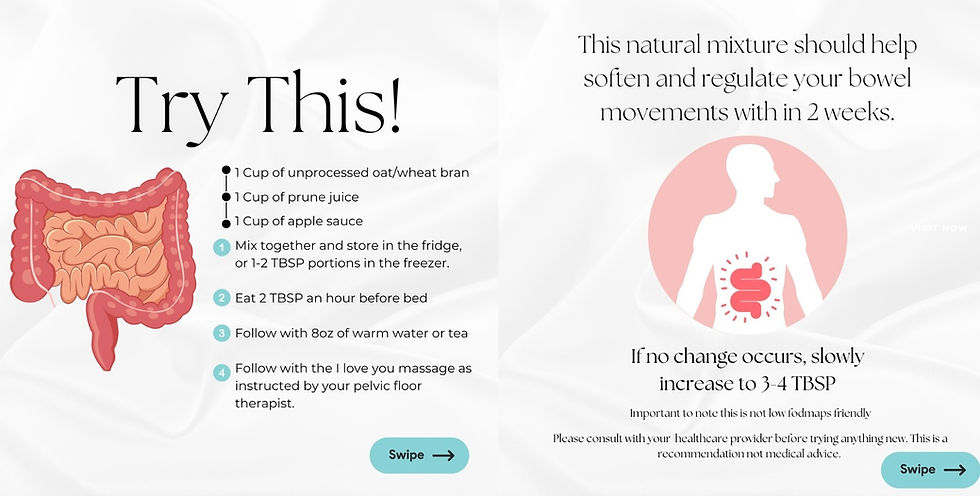
Bonus Tip For Added Fiber


Comments